Basketball Shot Selection Analytics: Boosting Team Efficiency
Explore the profound impact of optimized basketball shot selection on team efficiency. This deep dive reveals how data-driven decisions on the court are leading to significant improvements and shaping the future of the game.
By: pedropadm2025@gmail.com on agosto 22, 2026
In the fast-evolving world of professional basketball, the pursuit of marginal gains has become paramount. One of the most significant shifts in modern strategy revolves around basketball shot selection, transforming how teams approach offense. This season, a noticeable trend has emerged: teams that have meticulously analyzed and adjusted their shot selection are reporting efficiency boosts, sometimes as high as 8%.
This deep dive will explore the intricate analytics behind these changes, examining how data-driven decisions are reshaping offensive strategies. We will look at the types of shots prioritized, the zones from which teams are encouraged to shoot, and the underlying mathematical models guiding these crucial choices. Understanding these strategic adjustments is key to appreciating the current landscape of high-level basketball and predicting its future trajectory. The impact of refined shot selection extends beyond individual player performance, directly influencing overall team success and championship aspirations.
The Evolution of Shot Selection Analytics in Basketball
The game of basketball has always been about putting the ball in the hoop, but the methods and philosophies behind how players attempt to score have undergone a dramatic transformation. Historically, coaches relied on intuition, traditional scouting, and basic statistics like field goal percentage. While these methods held their own for decades, the advent of advanced analytics has ushered in a new era, providing unprecedented insights into the true value of different types of shots. This shift began subtly, with early adopters recognizing the inherent inefficiency of certain mid-range jumpers compared to attempts closer to the basket or from beyond the arc.
Today, sophisticated tracking systems and data analysis tools are standard equipment for most professional teams. These tools collect vast amounts of data on every possession, every shot, and every player movement. This granular data allows analysts to calculate expected point values for various shot locations and situations, moving beyond simple percentages. For instance, a shot taken at the rim, even if missed, often leads to offensive rebounds or free throws at a higher rate than a contested long two-pointer. Understanding these secondary effects is crucial for a complete picture of shot value. The result is a more scientific approach to offense, where every shot attempt is evaluated not just on whether it goes in, but on its long-term probability of generating points for the team.
This analytical revolution has fundamentally altered offensive playbooks. Teams are now actively discouraging shots from historically popular but statistically inefficient areas, pushing players towards higher-value attempts. This isn’t just about encouraging three-pointers; it’s about identifying the most opportune moments and locations for every type of shot, including layups and dunks. The emphasis has shifted from simply taking open shots to taking the best open shots, a nuance that makes a significant difference over the course of a 48-minute game and an 82-game season. The ongoing evolution means that what’s considered an optimal shot today might be refined further tomorrow as more data becomes available and analytical models improve.
Identifying High-Efficiency Shot Zones
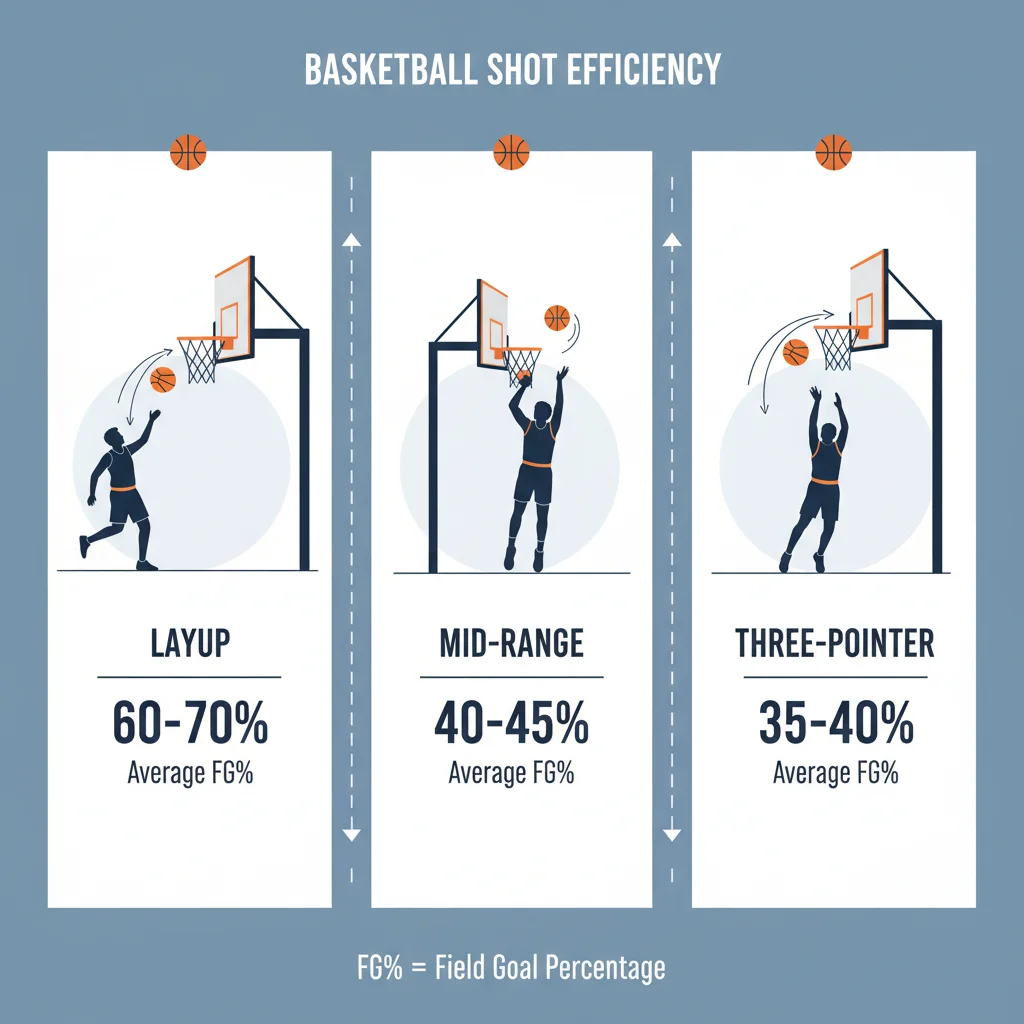
One of the cornerstones of modern basketball analytics is the identification and exploitation of high-efficiency shot zones. These are specific areas on the court from which players are statistically most likely to generate the highest expected points per possession. The most obvious of these zones is, of course, directly at the rim. Layups and dunks, despite being only two points, offer the highest field goal percentages and often lead to free-throw opportunities, significantly boosting their expected value. Teams actively design plays to get players to the basket, recognizing the unparalleled efficiency of these attempts.
Beyond the paint, the three-point line represents another crucial high-efficiency zone. A made three-pointer is worth 50% more than a made two-pointer, meaning a team can have a lower three-point shooting percentage than their two-point percentage and still generate more points per attempt. This mathematical advantage has led to a dramatic increase in three-point attempts across all levels of basketball. However, not all three-pointers are created equal. Corner threes, being closer to the basket and often offering a wider-open look, are typically more efficient than above-the-break threes. Analytics helps pinpoint these distinctions, guiding offensive strategies to prioritize the most advantageous three-point opportunities.
Conversely, the mid-range area, particularly long two-pointers, has largely been identified as a low-efficiency zone. While skilled players can certainly make these shots, the expected points per possession from these areas are generally lower than shots at the rim or from three-point range. Modern offenses actively try to minimize attempts from these inefficient areas, instead encouraging players to either drive to the basket for a layup or kick out for a three-point attempt. This strategic avoidance of mid-range shots, sometimes referred to as the ‘Moreyball’ philosophy, has become a widespread standard. By understanding and consistently targeting these high-efficiency zones, teams can significantly improve their overall offensive output and gain a competitive edge.
Translating analytical insights into actionable on-court strategies requires a concerted effort from coaches, players, and the front office. It’s not enough to simply know which shots are efficient; teams must actively train and design plays that consistently generate those high-value attempts. This implementation begins in practice, where players are drilled on offensive sets that create open looks at the rim or from beyond the three-point line. Drills are often designed to simulate game-like situations, reinforcing the importance of making quick, data-informed decisions about when and where to shoot.
Coaching and Player Development
Strategic Play Calling: Coaches use analytics to develop playbooks that minimize low-efficiency shots and maximize high-efficiency attempts. This includes specific sets designed to create corner threes or clear lanes to the basket.
Player Education: Players are educated on the ‘why’ behind the shot selection philosophy. Understanding the statistical advantages helps them buy into the system and make better decisions in the heat of the moment.
Skill Development: Training focuses on improving proficiency in high-value shots, such as finishing at the rim through contact, developing a consistent three-point shot, and making quick decisions with the ball.
Feedback Loops: Post-game analysis provides immediate feedback on shot selection, allowing coaches to reinforce good habits and correct inefficient tendencies.
Beyond individual skill development, team chemistry and offensive flow are crucial. Players need to trust the system and each other to pass up a contested mid-range shot for a better look for a teammate. This often involves extensive film study, where players review their own shot charts and compare them to team goals. The goal is to create an offensive ecosystem where every player understands their role in generating the most efficient shots possible for the entire unit. This collaborative approach ensures that the data-driven strategies are not just theoretical but are effectively executed on the court, leading to tangible improvements in offensive efficiency.
Impact on Team Efficiency and Performance
The embrace of optimized basketball shot selection has had a profound and measurable impact on team efficiency and overall performance. Teams that successfully implement data-driven offensive strategies often see a significant increase in their effective field goal percentage (eFG%), a statistic that accounts for the added value of three-pointers. This improvement in eFG% directly translates to more points scored per possession, which is a key indicator of offensive efficiency. An 8% boost in efficiency, as noted this season, is a substantial gain that can turn a good offensive team into a great one, or elevate a struggling offense to respectability.
Beyond raw scoring, improved shot selection influences several other critical aspects of team performance. By prioritizing high-percentage shots, teams reduce turnovers that often result from difficult, contested attempts. They also tend to generate more offensive rebounds, as shots closer to the basket or from established three-point zones often create more predictable rebound trajectories. This leads to more second-chance opportunities, further boosting offensive output. The psychological effect on players is also significant; consistently taking good shots can build confidence and reduce offensive slumps, knowing that their attempts are statistically sound.
The ripple effect extends to defensive performance as well. When an offense is efficient and takes good shots, it often means fewer long rebounds that lead to fast breaks for the opponent. This allows the defense to get back and set up more effectively, reducing transition points allowed. Therefore, a well-executed shot selection strategy isn’t just about scoring; it’s about creating a more balanced and effective overall team dynamic. The data unequivocally shows that teams committed to this analytical approach are more likely to win games, make the playoffs, and contend for championships, solidifying the importance of this modern basketball philosophy.
Challenges and Future of Shot Selection Analytics
While the benefits of advanced shot selection analytics are clear, implementing and continuously refining these strategies comes with its own set of challenges. One major hurdle is player buy-in. Players, especially veterans, may have ingrained habits and preferences for certain shots that are not analytically optimal. Convincing them to alter their game, sometimes significantly, requires strong communication, trust in the coaching staff, and tangible evidence of improved performance. It’s a delicate balance between respecting a player’s natural talent and guiding them towards more efficient decision-making. Another challenge is the dynamic nature of the game; defensive schemes constantly evolve to counter offensive strategies, meaning shot selection analytics must also adapt.
The future of shot selection analytics promises even greater sophistication. We can expect to see more personalized analytics, where each player’s unique shooting profile, strengths, and weaknesses are factored into their optimal shot selection strategy. Instead of broad guidelines, players might receive highly specific recommendations based on their individual tendencies and statistical probabilities. Furthermore, real-time analytics, perhaps delivered through wearable technology or augmented reality, could provide immediate feedback to players on the court, guiding their decisions in the moment. The integration of artificial intelligence and machine learning will likely play a significant role, allowing systems to identify patterns and predict optimal shot opportunities with even greater accuracy.
Beyond individual players, future analytics will likely delve deeper into team-level adjustments against specific opponents. Game-planning will become even more data-intensive, with shot selection strategies tailored to exploit defensive weaknesses and counter opponent strengths. The goal will be to not just identify high-efficiency shots in a general sense, but to pinpoint the highest-efficiency shots available against a particular defensive scheme on a specific night. This continuous evolution means that teams that invest in cutting-edge analytics and embrace adaptability will maintain a significant competitive advantage, pushing the boundaries of offensive efficiency even further in the years to come.
Frequently Asked Questions
What is effective field goal percentage (eFG%) and why is it important?
Effective field goal percentage (eFG%) is a basketball statistic that adjusts for the fact that a three-point shot is worth more than a two-point shot. It gives a more accurate representation of a player’s or team’s shooting efficiency, making it a crucial metric for evaluating offensive performance in modern basketball.
How do analytics identify high-efficiency shot zones?
Analytics identify high-efficiency shot zones by collecting vast amounts of data on every shot attempt, including location, outcome, and surrounding defensive pressure. Statistical models then calculate the average points generated per attempt from various court locations, highlighting areas with the highest expected value.
Do all players benefit equally from changing their shot selection?
While most players can improve by optimizing their shot selection, the degree of benefit varies. Players with unique skills, like exceptional mid-range shooters, might have different optimal shot profiles. Analytics aims to find the best shot selection for each individual within the overall team strategy.
What role does coaching play in implementing new shot selection strategies?
Coaching is vital in implementing new shot selection strategies. Coaches must educate players on the analytical insights, design practices that reinforce desired shot types, and create offensive systems that consistently generate high-efficiency looks. Their leadership ensures player buy-in and effective on-court execution.
Is the mid-range shot completely eliminated in modern basketball?
No, the mid-range shot is not completely eliminated. While generally considered a lower-efficiency shot, it still has strategic value, especially for elite scorers who can consistently make them or when used to counter specific defensive schemes. The goal is to minimize inefficient mid-range attempts, not eliminate them entirely.
The analytical revolution in basketball, particularly concerning basketball shot selection, has fundamentally reshaped the sport. As we’ve explored, the meticulous identification of high-efficiency shot zones and the strategic implementation of data-driven offensive schemes have led to tangible improvements in team performance, with some teams experiencing an impressive 8% boost in efficiency this season. This isn’t merely a fleeting trend; it’s a testament to the power of combining statistical rigor with on-court execution, moving beyond traditional intuition towards a more precise and effective approach to offense.
From the evolution of analytics tools to the challenges of player adaptation and the exciting prospects of personalized, real-time data, the journey of optimizing shot selection continues. Teams that embrace this analytical mindset, fostering a culture of continuous learning and adaptation, are the ones most likely to achieve sustained success in the competitive landscape of professional basketball. The future of the game will undoubtedly be defined by those who can best leverage data to make smarter decisions, ensuring that every shot taken is not just an attempt, but a calculated step towards victory. Engaging with these advanced strategies is essential for anyone looking to understand the cutting edge of basketball.
Peter B holds a degree in Journalism and has 5 years of experience covering U.S. economic policy, labor markets, and financial news. He writes data-driven news content on topics like inflation, interest rates, and employment trends.